


 3-in-1 Knife Sharpener
01
Size and fit
Check blade type, supported angles, and sharpening stages. Serrated and ceramic blades need explicit compatibility.
Choosing well
Start with your routine, the right size, and the care it needs.
3-in-1 Knife Sharpener
Check blade type, supported angles, and sharpening stages. Serrated and ceramic blades need explicit compatibility.
 Dual-Sided Stainless Steel Cutting Board with Sharpener
Set the tool on a stable surface and follow the indicated direction. Avoid excessive pressure or unnecessary repeated passes.
 Magnetic Knife Sharpening Kit 15 pieces
Remove residue and store dry as instructed. Follow the care guidance for the abrasive components.
Need help choosing?
Contact us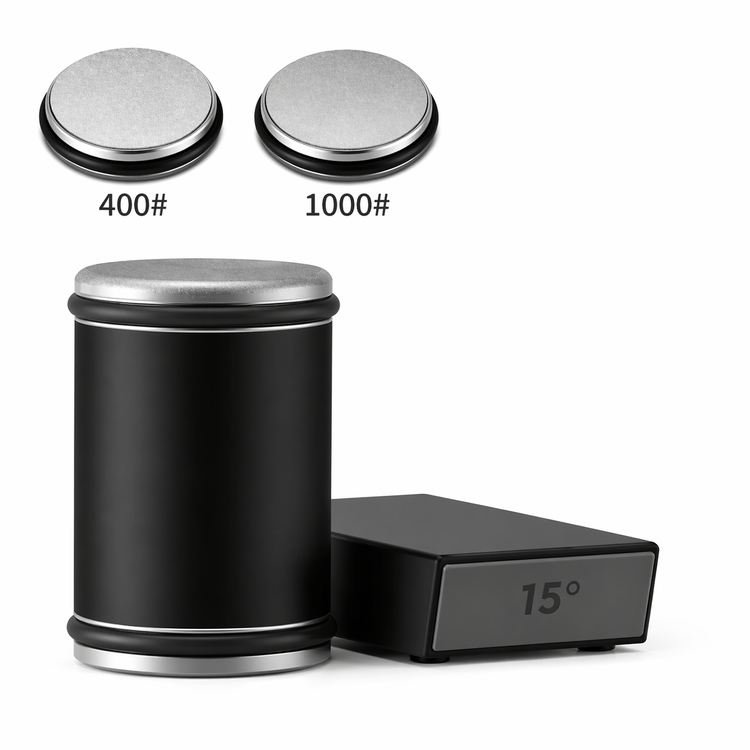
A dull knife is more dangerous than a sharp knife. When the blade no longer bites into the food, it slips, veers, and makes you work harder. The result: fatigue, lack of precision, and a higher risk of cuts. Sharpening your knives regularly brings back the pleasure of effortless cutting, and it’s also an essential maintenance step to extend the life of your blades over time. A well-maintained knife cuts cleanly, preserves the fibers in food, and makes every prep more enjoyable. Whether you're preparing vegetables on a cutting board or if you slice meat, a perfect edge changes everything.
The edge on a blade wears down gradually with each use, even on a good wooden cutting board. On hard surfaces like stainless steel or glass, this wear is much faster. The metal bends or wears away, creating micro-irregularities invisible to the naked eye but very noticeable when cutting. Sharpening removes this damaged material to reveal a fresh, clean edge. The longer you wait, the longer the work takes. That’s why regular, light care is always better than a deep sharpening once a year.
There are several families of sharpeners, each suited to a different use and skill level.
The magnetic roller sharpener is the most accessible solution. It automatically guides the blade at the ideal angle, with no adjustment or special experience needed. Simply roll the knife over the sharpening disk to get a consistent, repeatable result. It’s the ideal tool if you cook every day and want professional results in just a few passes.
The angle guide used with your existing sharpening stone. It solves the most common problem for home cooks: keeping a steady angle לאורך the full length of the blade. Without a fixed guide, the angle varies from one pass to the next and the result is uneven. The guide removes this problem simply and effectively.
The double-sided diamond sharpening rod is the tool for everyday upkeep. Compact and ready to use right away, it restores bite to a slightly dull blade in just a few quick passes. It doesn't replace deep sharpening, but it helps maintain the edge between sessions.
Multi-grain kit is intended for cooks who want to control their technique and achieve truly professional results. From coarse grit to touch up damaged blades, to fine grit for polishing and refining the edge, each step adds precision.
If you cook every day and want effortless maintenance, the magnetic roller sharpener is for you. If you already have a sharpening stone but get uneven results, an angle guide is enough to fix everything. If you like a hands-on technique and want professional-level results, choose a complete multi-grit kit.
Practical tip: the sharpening angle depends on the type of knife. For a Japanese knife like a santoku or gyuto, work at 15°. For a classic Western chef's knife, 20° is the standard. A bad angle weakens the blade instead of sharpening it.
Sharpening your knives regularly is pointless if the cutting surface dulls the blade every time you use it. The stainless steel cutting boards are hygienic but hard on blades. The wood cutting boards and acacia, on the other hand, are gentler and naturally preserve the edge. They absorb the impact of the blade instead of pushing it away. For the best care of your knives, the ideal setup is to combine a good sharpener with a cutting board suited to your blades.
For everyday home use, a quick pass with a diamond sharpening rod or honing steel after each cooking session is enough to keep the edge sharp. A deeper sharpening with a stone or roller sharpener is recommended every four to six weeks depending on how heavily it is used. Chef's knives used several times a day deserve more frequent maintenance. A knife that catches or crushes instead of slicing is a clear sign it's time to act.