

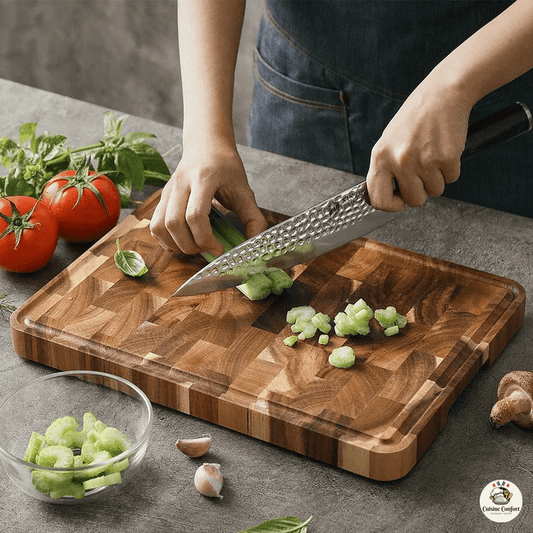


 Solid Oak Cutting Board
01
Size and fit
Compare size, thickness, and listed weight. Make sure the board fits your counter, sink, and storage space.
Find your everyday board
Explore stainless steel, wood, and checkerboard designs in a range of sizes and finishes.
Choosing well
Start with your routine, the right size, and the care it needs.
Solid Oak Cutting Board
Compare size, thickness, and listed weight. Make sure the board fits your counter, sink, and storage space.
 Acacia Cutting Board with Juice Groove
For prep or serving, check both faces, any grooves, and the grip details shown for this specific board.
 Acacia Checkerboard Cutting Board
Hand wash, avoid soaking, and dry after cleaning. Use a food-contact cutting board oil when recommended for your model.
Need help choosing?
Contact us
Also called end grain or wood end, checkerboard cutting boards represent the best in cutting comfort, durability, and knife protection.
Their geometric pattern is not just decorative. It comes from a specific construction technique where the wood fibers are oriented vertically toward the blade. Result: the knife moves between the fibers instead of cutting straight through them, which reduces wear on the cutting board while preserving knife sharpness.
That is exactly why end grain cutting boards have been used for years in professional kitchens. To discover other solid wood models, also explore our collection of wooden cutting boards.
The vertical fibers naturally close back up after the blade passes and limit deep marks.
The contact with the blade is gentler than with a standard cutting board or a very hard surface.
The weight and thickness of checkerboard cutting boards provide excellent stability on the countertop.
The checkerboard pattern instantly gives the kitchen and table a high-end finish.
On a classic cutting board with horizontal grain, each knife stroke gradually cuts into the surface. With an end grain cutting board, the blade enters between the fibers instead of cutting them directly.
This unique structure explains why checkerboard cutting boards show much less wear over time. They stay smoother, more stable, and more pleasant to use even after years of heavy cutting.
The hardwoods used to make them — maple, walnut, beech, or acacia depending on the model — also offer excellent natural density that helps limit the absorption of liquids and odors.
What immediately sets a checkerboard cutting board apart is its geometric pattern made by alternating light and dark woods assembled in regular squares.
This visual finish brings real presence to the countertop and turns the cutting board into a true decorative kitchen item. Some models also include a juice groove or non-slip feet to further improve ease of use.
A checkerboard cutting board can also be used directly at the table to serve bread, cheese, or cured meats. To coordinate your presentations, also discover our round cutting boards.
The right size depends directly on how you cook and the space available in your kitchen.
| Format | Ideal for |
| Under 30 cm | Small kitchens, quick cuts, cheese, bread or fruit |
| 30 to 40 cm | Versatile everyday use and regular meal prep |
| 40 cm and over | Large prep jobs, intensive cooking, and maximum stability |
Thicker models generally offer better stability on the countertop and a more professional feel while cutting.
If you want to compare different styles and materials, also explore our complete collection of cutting boards.
An end grain cutting board takes much more work to make than a standard cutting board. Each wood block must be cut, assembled, and precisely aligned to create the checkerboard pattern and ensure the whole piece is strong.
This longer manufacturing process creates a surface that is much more durable and gentler on knives. A well-maintained checkerboard cutting board can last for many years without losing stability or cutting quality.
Always wash your cutting board by hand with warm water and a mild soap.
Dry the surface immediately after rinsing to preserve the joints.
Oil the cutting board every 4 to 6 weeks with a suitable food-safe oil.
The dishwasher and prolonged soaking can crack the wood and weaken the glue joints.
Well maintained, an end grain cutting board is a true long-term investment. If you like solid wood and natural finishes, check out our acacia cutting boards.
An end grain cutting board is made with the wood fibers oriented vertically toward the blade. This design better protects knives and limits cut marks.
Their manufacturing is much more complex and requires more assembly and finishing work than a standard cutting board.
Yes. Their structure absorbs contact with the blade better and helps keep the edge sharp longer.
Yes, models with a juice groove are especially practical for meat and moist foods.
Wash it by hand, dry it immediately, and regularly apply a food-safe oil suitable for wood.
Checkerboard cutting boards are designed for cooks looking for a durable, stable surface that is pleasant to use every day.
Give your kitchen an end grain cutting board designed to last and protect your knives year after year.